 4 Minutes
4 Minutes

Paper checks have existed for more than 100 years, and while they have slowed in use, checks persist in the business world — and banks are wise to take advantage of this loyalty to paper payments.
While the advent of digital payments triggered a general decline in check use, paper payments are still being used at a consistent rate according to recent data from the Federal Reserve. One reason they’ve been able to endure the past century is due to their ability to evolve. From embedded safety features to digitization through image capture, checks have carved out space in the modern payments world. Although faster methods like peer-to-peer and real-time payments have undoubtedly disrupted the industry, reporting show that checks aren't declining at the speed they once were.
At a recent Deluxe-hosted seminar, Glen Sarvady, CEO of 154 Advisors, shared his expert opinion on the staying power of checks. He was joined by Anna Klingseisen, Executive Director of Regional/National Client Management and Sales at Deluxe.
“No one is claiming the checks aren't declining,” Sarvady stated. “But the real message is they're just not going away. The average consumer wrote 1.2 checks per month in October 2024, and that number hadn't come down. People think checks are going away, but they aren't.”
“This is my number one topic with clients,” Klingseisen concurred. “Is check use declining? Yes. Are checks falling off a cliff? No, meaning the check program can still be a viable payment method along with all the other adoptions that are happening within the ecosystem.”
Who is writing checks?
Checks still account for more than one-fifth of U.S. non-cash exchange, and a majority of that payment volume comes from businesses. According to a 2023 check sample study, the number of checks sent from businesses to other businesses was 3.3 billion, totaling $15.7 trillion in value. Businesses also issue checks to consumers and vice versa, to the tune of $5.1 and $1.9 trillion respectfully.
“When businesses write checks, they're larger.” Sarvady affirmed. “That also means the average value of a check continues to increase.”
Small businesses, big check use
While businesses of all sizes send and receive checks, a closer look at the data shows that those on the smaller size are the biggest users.
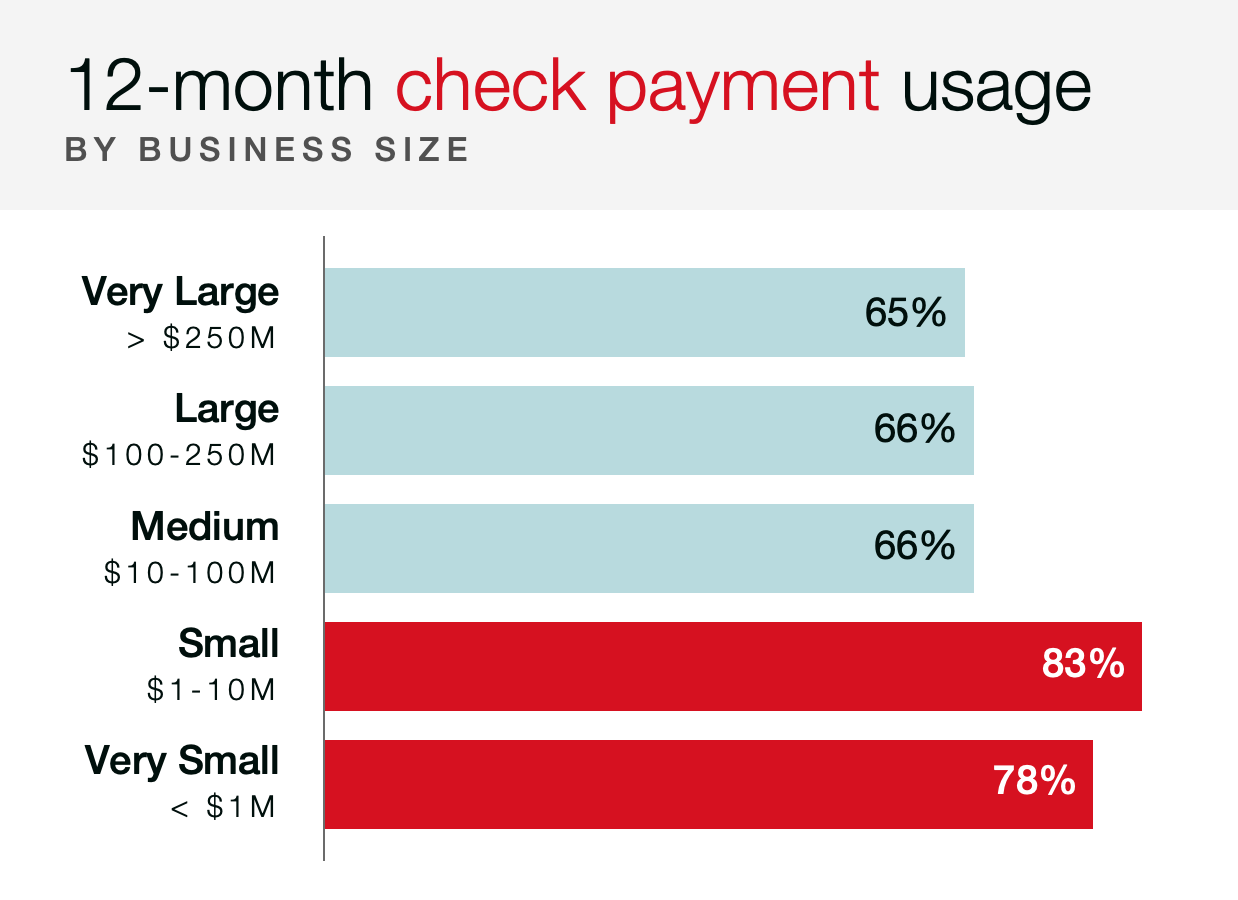
The Federal Reserve reports that medium- and large-sized businesses use checks at roughly the same rate (65-66 percent), but small businesses are very dependent on paper payments, with upwards of 83 percent reporting check payment use over a 12-month period.
Microbusinesses: Gray areas with impact
When it comes to extra small businesses — those eight employees or less — there are some gray areas. As Sarvady explained, “In that category, it can be difficult for a bank to tell if it's a consumer or a business because they often treat the accounts interchangeably.”
But just because the data is muddy, it doesn’t mean this group should be overlooked. “80 percent of small businesses are micro-businesses,” Sarvady explained, meaning they make up a significant market for business checking products.
Check use by industry
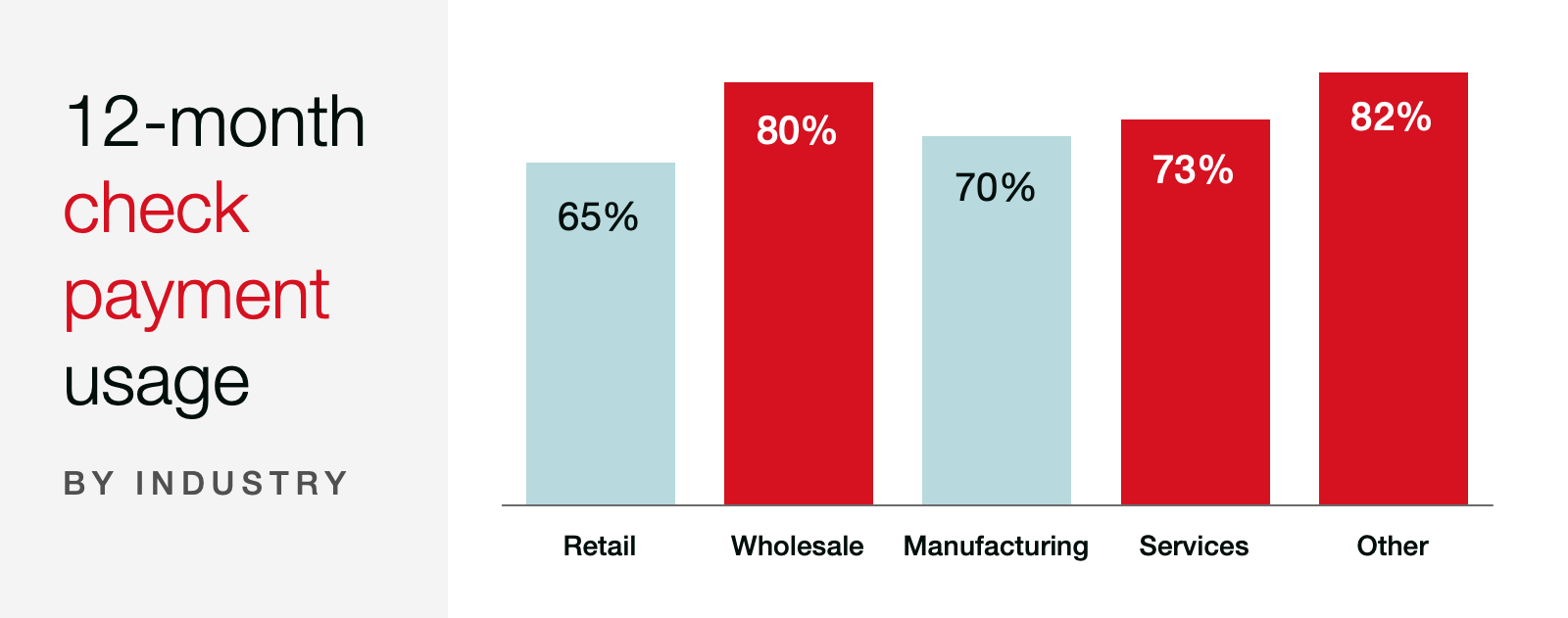
Data has established that businesses still use checks regularly — but which businesses specifically? In the same 2024 payments study, the Federal Reserve found that retailers and manufacturers were the least likely to use checks, while service providers, wholesalers and others miscellaneous businesses were most likely to send and receive check payments.
Based on this study, a dotted line can be drawn between industries made up of small businesses and industries with heavy check use. For small companies with just a handful of employees, every penny counts.
“Take contractors, for example,” Klingseisen explained. “You know, usually contractors will say, ‘I take credit card, but I’ll give 3% off if you write a check.’” It’s worth it for these smaller companies to save on credit card processing costs, and their customers are willing to write a check to get that discount.
Why do businesses continue to use checks?
Checks serve a meaningful role in the realm of business payments, especially among smaller organizations — and for good reason. Here are a few reasons why:
1. Paper trails
Part of the reason checks have remained a common payment tool between businesses is due to their rich remittance data. By their very nature, checks create a paper trail, making it easier for finance personnel to keep their books balanced.
“For small businesses, it's about operational needs,” clarified Klingseisen. “Business [banking] customers are experts in their space, but they need help managing different methods of payment. They're constantly looking for ways to operate efficiently and effectively, and the check is still one of those forms that offers that efficiency with remittance data.”
“Most of these small-business owners are sole proprietors,” said Sarvady. “And they're not in business to worry about things like accounting software if that makes their life easier.”
2. Convenience
Sarvady cites payroll convenience as another big driver for the persistence of check use: “Again, the average size of these micro-companies is eight employees, and a lot of them are smaller than that. Are they going to bother with a payroll service if they only have three employees to pay? No. They’re probably just going to write a check.”
3. Fee avoidance
Many modern payment processing methods and services come with added fees, costs that small business owners must absorb — another reason to write a check, according to Sarvady.
“Business owners use checks to avoid incurring a service charge. Whether it's positioned as a surcharge or a discount or whatever, if it's a big enough amount, you may be paying more if you wind up going through a card.”
What does this mean for financial institutions?
Deluxe predicts that 7 billion checks will still be written in 2030 — and for banks with business customers, that means checking programs are here to stay for the foreseeable future.
“This is why Deluxe continues to invest in our check program, because we’re still going into 2030 with that seven billion prediction,” Klingseisen said. “That's still a very big number. We want to ensure as a partner that we're providing the highest quality product banks can have in their portfolio.”
The staying power of checks among businesses means it’s essential to continue supporting check programs. Checks are likely to remain a viable stream of revenue for financial institutions — both in terms of fees and account holder profitability — for the foreseeable future.
Business check programs by Deluxe
Learn how you can transform your check program to meet the evolving needs of today’s account holder.
RECOMMENDED RESOURCES


